

The Best Used Trucks
for Hauling a Landscaping Trailer
Finding the right used truck for your landscaping business is a critical decision. You need a vehicle that can reliably haul a trailer packed with mowers, trimmers, and blowers day in and day out. The ideal truck balances powerful towing capabilities with sufficient payload for materials like mulch and soil, all while offering the durability to handle tough job sites. It is not just about raw power; it is about finding a smart investment that minimizes downtime and keeps your business running smoothly. From engine performance and drivetrain options to bed length and cab size, several factors determine which pre-owned truck is the perfect partner for your landscaping operations. Considering these key features will help you select a dependable workhorse that meets the demands of your daily schedule and fits within your budget, ensuring you get the most value and capability for your money.
Now that you know what to look for, the next step is finding the perfect match. Our extensive used inventory features a wide selection of capable and job-ready trucks from top manufacturers. We understand the unique needs of business owners and are here to help you find a vehicle that works as hard as you do. Explore our selection online or visit one of our locations to see these powerful trucks in person and find the ideal addition to your fleet.
A Deeper Dive into Selecting Your Landscaping Work Truck
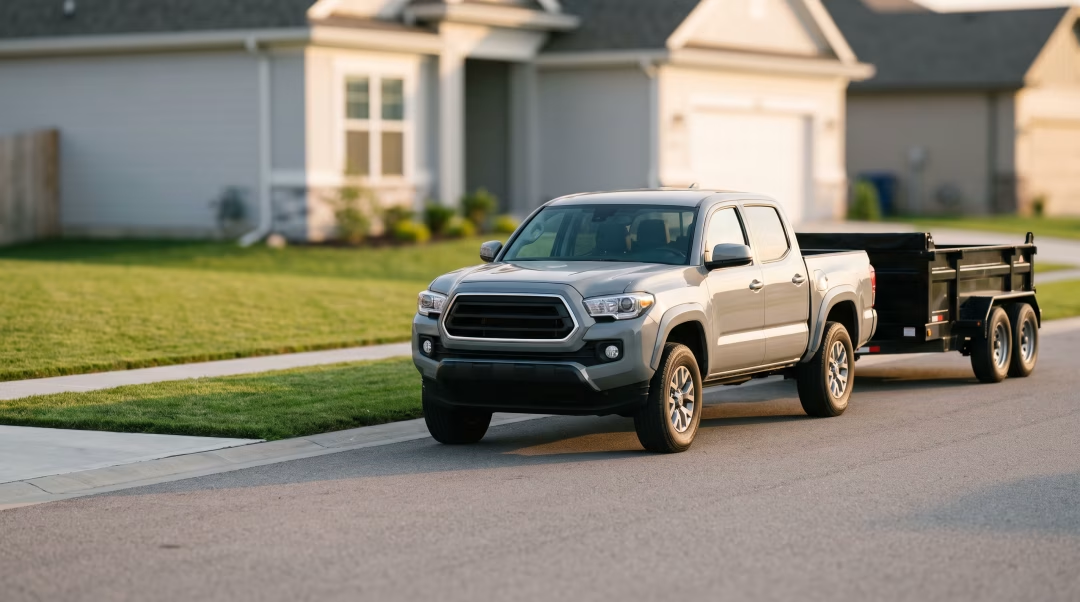
For a landscaper, a truck is more than just transportation; it is the backbone of the business. It is your mobile office, your tool shed, and your heavy equipment hauler all in one. Choosing the right used truck requires careful consideration of your specific needs, from the size and weight of your typical trailer to the type of terrain you navigate daily. A poor choice can lead to costly repairs, inefficient operations, and lost time, while the right truck can be a force multiplier for your productivity. Let us break down the essential characteristics you need to evaluate to find the best used truck for hauling your landscaping trailer.
Key Factors for Your Next Work Truck
Before you start browsing specific models, it is essential to understand the language of trucks and what specifications matter most for landscaping work. Focusing on these areas will narrow down your search and ensure you get a vehicle that is truly up to the task.
- Towing Capacity: This is arguably the most critical number. It dictates the maximum weight your truck can safely pull. You need to know the total weight of your trailer when fully loaded with all your equipment. Always choose a truck with a towing capacity that comfortably exceeds your trailer's weight. This provides a safety margin and reduces strain on the truck's engine, transmission, and brakes. You can learn more about what towing capacity really means on our blog.
- Payload Capacity: Do not overlook the weight of what goes in the truck bed. Payload refers to the maximum weight you can carry in the cab and bed combined. Think about bags of fertilizer, soil, pavers, or even a push mower. Exceeding your payload can damage the suspension and create an unsafe driving condition.
- Engine and Drivetrain: The engine is the heart of your truck. V8 gasoline engines are a popular, powerful, and reliable choice. For those pulling exceptionally heavy trailers or covering long distances, a turbo-diesel engine might offer better torque and fuel efficiency. You will also need to decide between a two-wheel drive (4x2) or four-wheel drive (4x4) system. A 4x4 is essential if you frequently work on muddy, unpaved, or hilly job sites. For more details, compare gas vs. diesel used trucks.
- Bed and Cab Size: A standard 6.5-foot or long 8-foot bed is usually best for landscaping to accommodate tools, debris, and materials. The cab size depends on your crew. A Regular Cab is fine for a solo operator, but an Extended or Crew Cab is necessary if you regularly transport a team to job sites. Our guide on Crew Cab vs. Extended Cab can help you decide.
Top Used Truck Models for Landscaping Professionals
While many trucks can get the job done, some models have consistently proven their worth in demanding commercial environments. Here are a few of the best used trucks to consider for your landscaping business, known for their capability, reliability, and value.
Ford F-150
The Ford F-150 has been a best-seller for decades for a reason. Its wide range of engine options, including powerful V8s and torquey EcoBoost V6s, means there is an F-150 for almost any towing need. Its aluminum body (on 2015 and newer models) helps reduce the truck's weight, which can contribute to a higher payload capacity. The F-150 is a versatile, dependable all-arounder that is easy to find on the used market, making it a top choice for many landscapers.
Chevrolet Silverado 1500 & GMC Sierra 1500
The Silverado and its GMC twin, the Sierra, are titans in the truck world. They are celebrated for their robust V8 engines that deliver proven power and durability. These trucks offer a comfortable ride, which is a significant plus after a long day of physical labor. Their straightforward, no-nonsense design and strong frames make them excellent candidates for daily work duty. Finding parts and service is simple, which is another key consideration for a business vehicle.
Ram 1500
The Ram 1500 often stands out for its unique rear suspension setup (on many later models), which uses coil springs instead of traditional leaf springs. This can provide a smoother, more composed ride, especially when the bed is empty. The available HEMI V8 engine is a legendary powerhouse, providing ample muscle for towing. For those prioritizing fuel economy, some model years offer an efficient EcoDiesel engine that still delivers impressive torque for pulling.
Heavy-Duty Options: Ford F-250, Ram 2500, Silverado 2500HD
If your landscaping trailer is a large, tandem-axle model loaded with heavy zero-turn mowers or a compact tractor, you may need to step up to a three-quarter-ton truck. Models like the Ford F-250, Ram 2500, or Chevy Silverado 2500HD offer significantly higher towing and payload capacities. Their stronger frames, beefier suspensions, and larger brakes are built for serious work. If you feel your half-ton might be strained, learning about the differences between half-ton vs. three-quarter-ton trucks is a wise next step.
Financing Your Business's Next Asset
Acquiring the right truck is an investment in your business's future. We understand that managing cash flow is vital for any company, which is why we offer flexible financing solutions. Whether you have an established business credit history or are just starting, our team is here to walk you through the process. You can start by filling out our online application or learning more about our financing area. If you are upgrading your current vehicle, you can also easily value my trade to see how much you can put toward your next work truck.
What towing capacity do I need for a landscaping trailer?
First, calculate the total weight of your trailer plus all the equipment you regularly haul. A typical single-axle landscape trailer might weigh 4,000-6,000 pounds when loaded. It is recommended to choose a truck with a towing capacity at least 1,500 pounds higher than your total weight to provide a safe buffer and reduce strain on the vehicle.
Is a V8 engine necessary for a landscaping truck?
While not strictly necessary, a V8 engine is often the best choice for its balance of power, durability, and proven reliability for towing. Modern turbocharged V6 engines, like Ford's EcoBoost, can also provide similar or even better torque figures. The most important factor is having enough torque to get your trailer moving without overworking the engine.
Should I get a four-wheel drive (4x4) truck for landscaping?
This depends entirely on your job sites. If you only work on paved suburban lots, a two-wheel drive (4x2) truck is sufficient and often more affordable. However, if you frequently encounter mud, wet grass, loose gravel, or hilly terrain, a 4x4 system provides essential traction to prevent getting stuck and to maneuver your trailer safely.
What is more important: payload or towing capacity?
For hauling a landscaping trailer, towing capacity is the primary concern. However, payload is also very important. You must account for the trailer's tongue weight (typically 10-15% of the total trailer weight) as part of your payload, in addition to any tools, materials, passengers, and gear in the truck itself. Both numbers are critical for safe and legal operation.
How many miles is too many for a used work truck?
There is no magic number, as maintenance history is far more important than the odometer reading. A well-maintained truck with 150,000 miles can be more reliable than a neglected one with 80,000 miles. Look for vehicles with service records. For work trucks, especially diesel models, higher mileage is common and not necessarily a red flag if the truck has been properly cared for.
