

What Does It Mean When
Your Tire Pressure Light Comes On?
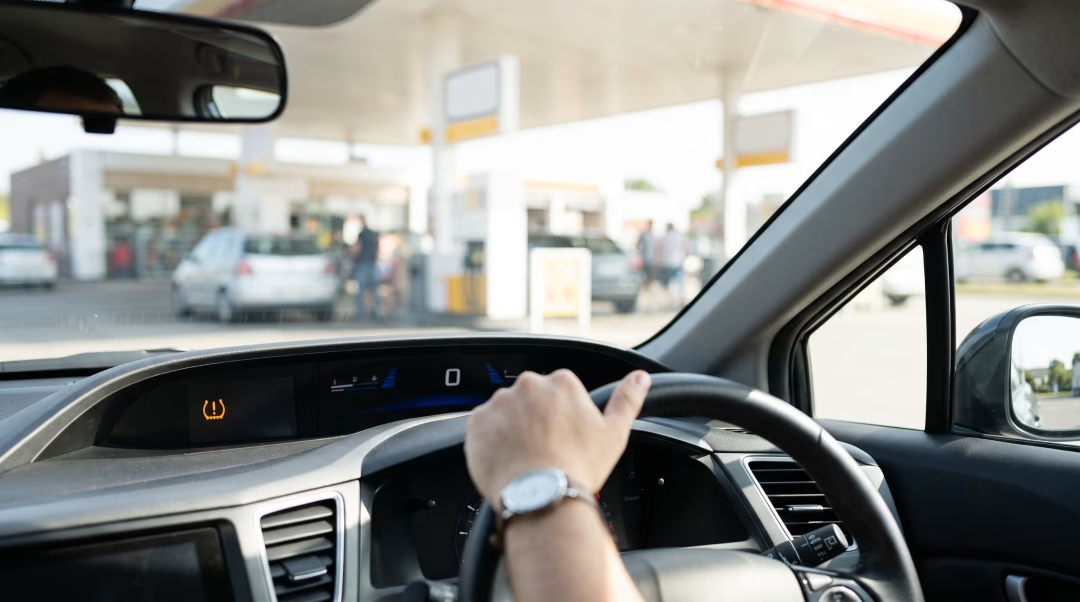
That small, amber-colored symbol on your dashboard shaped like a tire cross-section with an exclamation point can be a source of sudden anxiety. This is your vehicle's Tire Pressure Monitoring System (TPMS) light, a crucial safety feature in modern cars. Its purpose is to alert you when one or more of your tires are significantly under-inflated, creating a potentially unsafe driving condition. Ignoring this warning can lead to poor handling, increased braking distances, reduced fuel efficiency, and uneven tire wear. In a worst-case scenario, it could even result in a dangerous tire blowout. Understanding what this light means and what to do when it illuminates is a key part of responsible vehicle ownership. Taking prompt action not only keeps you safer on the road but also helps extend the life of your tires, saving you money in the long run. When you see this light, it is your car's way of asking for a quick check-up.
Maintaining correct tire pressure is one of the easiest and most effective ways to ensure your vehicle performs as it should. It is a fundamental aspect of car care that impacts everything from your budget to your safety. Here at our dealership, we take pride in offering a wide used inventory of vehicles that have been thoroughly inspected. We believe an informed driver is a safer driver, which is why we want to provide you with the knowledge to handle common issues like a TPMS warning light with confidence.
A Deeper Dive into Your Tire Pressure Monitoring System (TPMS)
The TPMS is an electronic system designed to monitor the air pressure inside your vehicle's tires. Mandated in the United States for all passenger vehicles manufactured after September 2007, this system represents a significant step forward in automotive safety technology. When it detects that a tire's pressure has fallen below a certain threshold, typically 25% below the manufacturer's recommended level, it activates the warning light on your instrument cluster. There are two primary types of TPMS systems used by automakers: direct and indirect.
- Direct TPMS (dTPMS): This system uses individual pressure sensors mounted inside each tire, including, in some cases, the full-size spare. Each sensor has its own battery and directly measures the air pressure, transmitting this data wirelessly to the car's main computer. This is the more accurate of the two systems and can often identify which specific tire is low.
- Indirect TPMS (iTPMS): This system does not use dedicated pressure sensors in the tires. Instead, it works with the car's Antilock Braking System (ABS) wheel speed sensors. It functions on the principle that an under-inflated tire has a slightly smaller diameter, causing it to rotate at a higher speed than the other tires. The system detects this difference in rotation speed and triggers the warning light. While less expensive for manufacturers, iTPMS is generally less accurate and cannot pinpoint the specific low tire.
Regardless of which system your car has, the warning light serves the same critical purpose: to get your attention and prompt you to check your tires.
Common Reasons for a TPMS Light Illumination
Seeing the TPMS light does not automatically mean you have a major problem, but it always warrants investigation. Several factors can cause the light to come on.
Natural Air Loss and Slow Leaks: Tires are not perfectly airtight and will naturally lose about 1 pound per square inch (PSI) of pressure each month. A small puncture from a nail or screw can also cause a slow, persistent leak that eventually triggers the light. When shopping for a vehicle, it is always a good idea to know how to check tire condition on a used car.
Sudden Temperature Drops: This is perhaps the most common reason for the light to appear, especially during the first cold snap of autumn or winter. Air is a gas, and its volume changes with temperature. As the ambient temperature drops, the air inside your tires contracts, causing the pressure to decrease. A general rule of thumb is that for every 10°F drop in temperature, tire pressure will decrease by about 1 PSI. While the tire has not actually lost any air, the pressure is low enough to trigger the sensor.
A Flashing Light vs. a Solid Light: The behavior of the light itself provides a clue. If the light comes on and stays on (solid), it almost always means one or more tires have low pressure. However, if the light flashes for 60 to 90 seconds when you start the car and then remains lit, this typically signals a malfunction within the TPMS itself. This could be a dead battery in one of the direct sensors, a faulty sensor, or a problem with the system's receiver. A flashing light requires professional diagnosis to resolve and will prevent the system from monitoring your tire pressure correctly.
What to Do When the Tire Pressure Light Comes On
When that little light appears, do not panic. Follow these simple steps to diagnose and address the issue safely.
- Find a Safe Place to Pull Over: As soon as it is safe, pull over to a level, stable surface away from traffic, like a parking lot or a well-lit side street. Turn on your hazard lights.
- Perform a Visual Inspection: Walk around the vehicle and look at all four tires. Is one visibly flat or much lower than the others? If you have a completely flat tire, you should not drive on it. You will need to change to your spare tire or call for roadside assistance. If they all look okay, the pressure is likely low but not critically so.
- Check the Pressure Manually: This is where a reliable tire pressure gauge becomes an essential tool for any car owner. You need to know the correct pressure for your vehicle. This information is NOT printed on the tire itself; that number is the maximum pressure the tire can hold. The manufacturer's recommended pressure is found on a sticker inside the driver's side doorjamb. Unscrew the valve stem cap, press the gauge firmly onto the valve stem, and read the pressure. Check all four tires.
- Inflate to the Correct PSI: If you find one or more tires are low, drive to the nearest gas station with an air compressor. Add air in short bursts, checking the pressure with your gauge as you go until you reach the recommended PSI. If the weather is cold, it can be a good idea to add 1-2 extra PSI to compensate, as the pressure will drop again as the tires cool down. Be careful not to over-inflate your tires, as this can also cause poor handling and uneven wear.
- Resetting the Light: In most vehicles, after you have inflated the tires to the proper pressure, the TPMS light will turn off on its own after you have driven for a few miles. This allows the system's sensors to transmit the new, correct pressure readings to the car's computer. Some older vehicles may have a manual TPMS reset button, often located in the glove box or below the steering wheel. Consult your owner's manual for the specific procedure for your car. If the light remains on after you have confirmed the pressure is correct and driven for several miles, you may have a system malfunction that needs professional attention.
The Lasting Importance of Tire Maintenance
Your tires are the only part of your vehicle that makes contact with the road. Keeping them in good condition is vital for your safety, your car's performance, and your wallet. Proper inflation is the cornerstone of this maintenance. It ensures optimal braking, cornering, and stability. It also maximizes fuel economy because under-inflated tires create more rolling resistance, forcing your engine to work harder. Finally, correct pressure promotes even tread wear, extending the life of your tires. For anyone considering a new vehicle, asking the right questions is key. Our guide on what questions to ask a dealer before signing can be a valuable resource. For more information, please feel free to contact us anytime.
Can I drive with the tire pressure light on?
It is not recommended to drive for an extended period with the light on. A solid light indicates low pressure, which compromises vehicle safety, handling, and fuel efficiency. You should pull over when safe, inspect your tires, and check the pressure as soon as possible. If the tire is not completely flat, you can usually drive slowly and cautiously to the nearest service station to add air.
Why did my tire pressure light come on when it got cold?
Air contracts in colder temperatures. For every 10-degree drop in ambient temperature, your tire pressure can decrease by approximately 1 PSI. This is a very common cause for the TPMS light to activate during the first cold spell of the season. Inflating your tires back to the recommended PSI will typically resolve the issue.
How do I turn off the tire pressure light?
Once you have inflated all tires to the correct pressure listed on your driver's doorjamb sticker, the light should go off by itself after you drive for several minutes. Some cars have a manual reset button, which you can find by checking your owner's manual. If the light does not go off, you may have a faulty sensor or a more persistent leak.
What is the difference between a solid and a flashing TPMS light?
A solid, steady light means the pressure in one or more of your tires is low and needs to be addressed. A light that flashes for about a minute when you start the car and then stays solid indicates a malfunction in the TPMS system itself. This could be a dead sensor battery or another fault that requires a professional diagnosis.
Does my spare tire have a TPMS sensor?
This depends on your vehicle. Many modern cars with a full-size spare tire include it in the TPMS system, meaning low pressure in the spare can trigger the warning light. However, smaller, temporary "donut" spares typically do not have a sensor. Check your owner's manual to confirm the specifics for your vehicle.
