

What Does Towing
Capacity Really Mean?
When you are browsing for a used truck or SUV, one of the most important specifications you will encounter is "towing capacity." But what does this number really mean? Simply put, towing capacity is the maximum weight a vehicle can safely pull behind it. It is a critical figure determined by the manufacturer through rigorous testing, taking into account the vehicle’s engine, transmission, frame, axles, brakes, and cooling system. Understanding this rating is not just about knowing if you can pull a boat or a camper; it is about ensuring the safety of yourself, your passengers, and others on the road. Exceeding your vehicle's limit can lead to severe mechanical strain, loss of control, and dangerous driving situations. Before you hitch up a trailer, it is essential to grasp the fundamentals of what this number represents and all the factors that contribute to it.
Choosing the right vehicle means matching its capabilities to your specific needs. Whether you plan on weekend trips to the lake, hauling equipment for your business, or taking the family on a cross-country RV adventure, the towing capacity is a non-negotiable part of the equation. Our team is here to help you navigate these specifications. By exploring our diverse used inventory, you can find a truck or SUV that not only fits your budget but also has the power and durability to handle your toughest jobs safely.
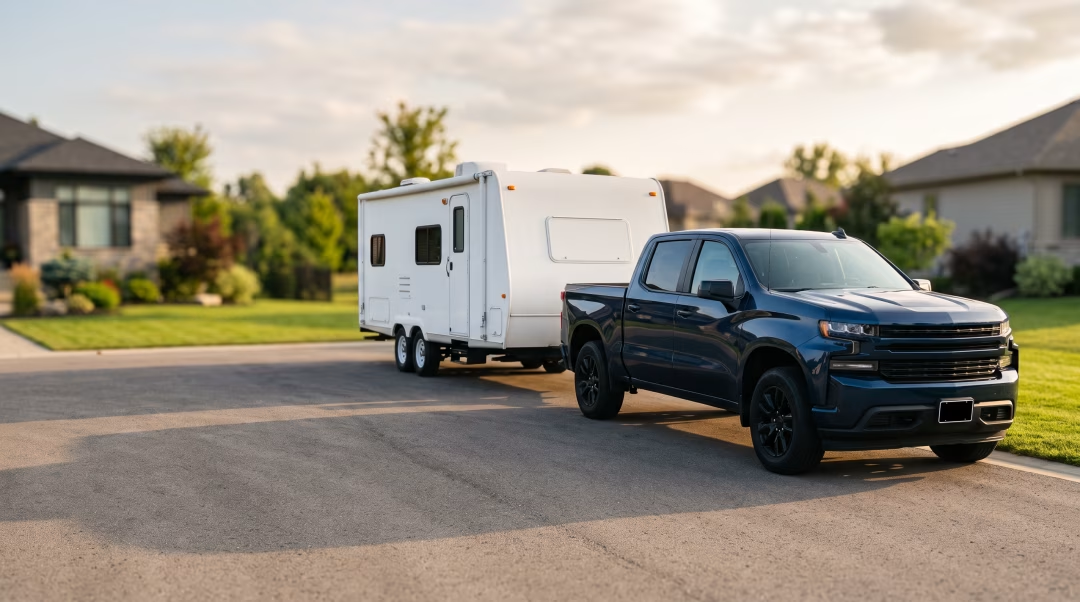
A Deeper Dive into Towing Terminology
To fully understand what towing capacity really means, you need to become familiar with a few key acronyms and terms that automakers and professionals use. These figures work together to define a vehicle’s limits. Ignoring them can mean making a poor purchasing decision or creating an unsafe towing setup. Here are the essential terms you should know before you start comparing vehicles or connecting a trailer.
- Gross Vehicle Weight Rating (GVWR): This is the maximum total weight of your fully loaded vehicle, including the vehicle itself (curb weight), all passengers, fuel, and any cargo in the cab or bed. You should never exceed the GVWR.
- Gross Combination Weight Rating (GCWR): This is the most important number for towing. It represents the maximum allowable weight of the fully loaded tow vehicle AND the attached, fully loaded trailer combined. It is the absolute weight limit for the entire rig.
- Curb Weight: This is the weight of the vehicle with all standard equipment and fluids (including a full tank of gas), but without any passengers or cargo.
- Payload Capacity: This tells you how much weight you can carry in your vehicle's cab and bed. It is calculated by subtracting the vehicle's curb weight from its GVWR. Remember, payload includes passengers, gear, and the trailer's tongue weight.
- Tongue Weight (or Pin Weight): This is the downward force that the trailer's tongue exerts on the hitch of the tow vehicle. Proper tongue weight (typically 10-15% of the total trailer weight for conventional trailers) is crucial for stable, safe towing. Too little tongue weight can cause trailer sway, while too much can overload the vehicle's rear axle.
How Vehicle Components Affect Towing Capacity
A vehicle's maximum towing capacity is not an arbitrary number. It is the result of a complex engineering equation that considers the strength and limitations of numerous interconnected systems. The final rating is only as strong as its weakest link. For instance, a powerful engine is useless for towing if the transmission overheats or the brakes are not sufficient to stop the combined weight. When you are looking at used trucks for towing, understanding these components is key.
The engine provides the raw power, with torque being a more critical figure than horsepower for getting a heavy load moving. The transmission must be able to handle that torque under stress without failing. Many trucks equipped with a tow package include an external transmission fluid cooler for this very reason. The vehicle's frame provides the foundational strength, while the suspension and axles must be robust enough to bear the vehicle's weight plus the downward force of the trailer's tongue weight. The axle ratio also plays a significant role; a higher numerical ratio (e.g., 4.10 vs. 3.55) provides more pulling power but may reduce fuel economy when not towing. Finally, the braking system must be capable of safely stopping the entire combined weight, not just the truck itself.
The Critical Importance of Staying Within Your Limits
It can be tempting to push the limits, assuming the manufacturer's rating is overly cautious. This is a dangerous mistake. Exceeding your vehicle's towing capacity puts immense strain on every major component, leading to a cascade of potential safety failures. The most immediate risk is loss of control. An overloaded vehicle will have compromised steering and stability, making it difficult to manage, especially in crosswinds or during emergency maneuvers. Trailer sway, a terrifying side-to-side oscillation, becomes much more likely.
Braking distance increases dramatically with excess weight, potentially making it impossible to stop in time to avoid a collision. The powertrain is also at risk. The transmission can overheat and suffer catastrophic failure, and the engine can be strained beyond its design limits. Over the long term, towing beyond capacity can even cause damage to the vehicle's frame and suspension, leading to costly repairs and an unsafe vehicle. Beyond the mechanical and safety risks, you could also face legal and financial consequences, including fines or liability in the event of an accident. Always prioritize safety by respecting the manufacturer's specified limits.
Finding the Right Vehicle for Your Towing Needs
Before you even start looking at trucks or SUVs, the first step is to know exactly what you plan to tow. Get the specific weight of your boat, camper, or trailer when it is fully loaded with all gear, water, and supplies. This is called the Gross Trailer Weight (GTW). Once you have that number, you can look for vehicles with a towing capacity that comfortably exceeds it. A good rule of thumb is to have a 15-20% buffer. This means if your trailer weighs 6,000 pounds, you should look for a vehicle rated to tow at least 7,200 pounds. This safety margin accounts for miscalculations and ensures you are not constantly pushing your vehicle to its absolute limit.
As you explore our used inventory, pay close attention to the specifications of each vehicle. Do not assume all models of a certain truck have the same rating. Towing capacity can vary significantly based on the engine, drivetrain (2WD vs. 4WD), cab configuration, and axle ratio. If you have questions, our team is here to help you understand the details. Once you have found a potential match, you can get pre-qualified for financing to streamline the process. Making an informed choice based on your specific towing requirements will give you peace of mind on every journey.
What is the difference between towing capacity and payload?
Towing capacity refers to the maximum weight your vehicle can pull behind it, like a trailer. Payload capacity is the maximum weight your vehicle can carry in its cab and bed, which includes all passengers, cargo, and the trailer's tongue weight. These are two separate but related ratings, and you should never exceed either one.
Does adding passengers or cargo reduce my towing capacity?
Yes, indirectly. Your vehicle's maximum towing capacity is often calculated based on the GCWR (Gross Combination Weight Rating) minus the vehicle's curb weight. Adding passengers and cargo increases the tow vehicle's actual weight, which reduces the amount of trailer weight you can pull while staying under the GCWR limit.
How do I find my specific vehicle's towing capacity?
The most accurate information is found in your vehicle's owner's manual. You can also check the certification label on the driver's side door jamb, which lists the GVWR and axle ratings. The manufacturer's website often has detailed towing guides for specific model years, which can provide precise numbers based on your vehicle's configuration.
Is a 4x4 or 4x2 truck better for towing?
Both can be excellent for towing. A 4x2 (two-wheel drive) truck often has a slightly higher towing capacity because it weighs less than a comparable 4x4 model. However, a 4x4 (four-wheel drive) offers superior traction, which can be invaluable when pulling a heavy load on slippery surfaces like a wet boat ramp or a muddy campsite.
Do I need a special hitch for heavy loads?
Absolutely. Standard bumper hitches are only rated for very light loads. For heavier trailers, you will need a frame-mounted receiver hitch. For very large travel trailers or fifth-wheels, you will need a specialized weight-distributing hitch or a fifth-wheel/gooseneck hitch that mounts in the truck bed to ensure stability and safety.
